
What is Color?
And Why It Demands a New Worldview

Humans are predominantly visual animals. Color is critical for our perception of the world and an inseparable part of everyday experience. Yet the nature of color has never ceased to puzzle philosophers, physicists, psychologists, and neuroscientists for centuries.
We all know color is related to electromagnetic wavelengths of light in the physical world. But does color exist? Is it a property of an object? Is color a reality or an illusion? Is the experience of seeing a color unique to each of us? A seemingly simple question about color can spark endless controversy and leave people more unsettled than ever.
The main reason is that color has challenged our traditional worldview in both philosophy and science. As if a square attempts to fit into a round hole, the theory of color has bounced between objectivism and subjectivism, never settling on either side. Meanwhile, because color is so persuasive in our everyday life, including seeing, feeling, memory, conscious experience, and cultural impact, it has become a typical example for people to explain how the brain works and even what consciousness is. Understanding color is directly interwined with how much we understand the underpinnings of the mind.
In this article, we will first take a brief journey into color from neuroscience and philosophy perspectives, and then examine whether the experience of color reveals anything about consciousness. At the end, I hope you will agree with me that color is not an illusion. It is as real as our other senses, such as warmth and sound. All the debates around the nature of color stem from the reductionist frame we have used everywhere.
Neuroscience of Color
Humans can perceive colors because our eyes have three types of cone cells: L, M, and S, each with pigments responding to a specific range of light wavelengths. Their response curves are all bell-shaped, each with a maximum response value.
Many of us have been told that the peaks of each curve correspond to red, green, and blue, respectively, which is, in fact, not entirely true. As shown in the picture below, both the L- and M-cones are sensitive to the whole visible spectrum. The S-cones have their peak at a wavelength that would appear violet under neutral viewing conditions, and the L-cones have their peak at a wavelength that would appear yellowish.
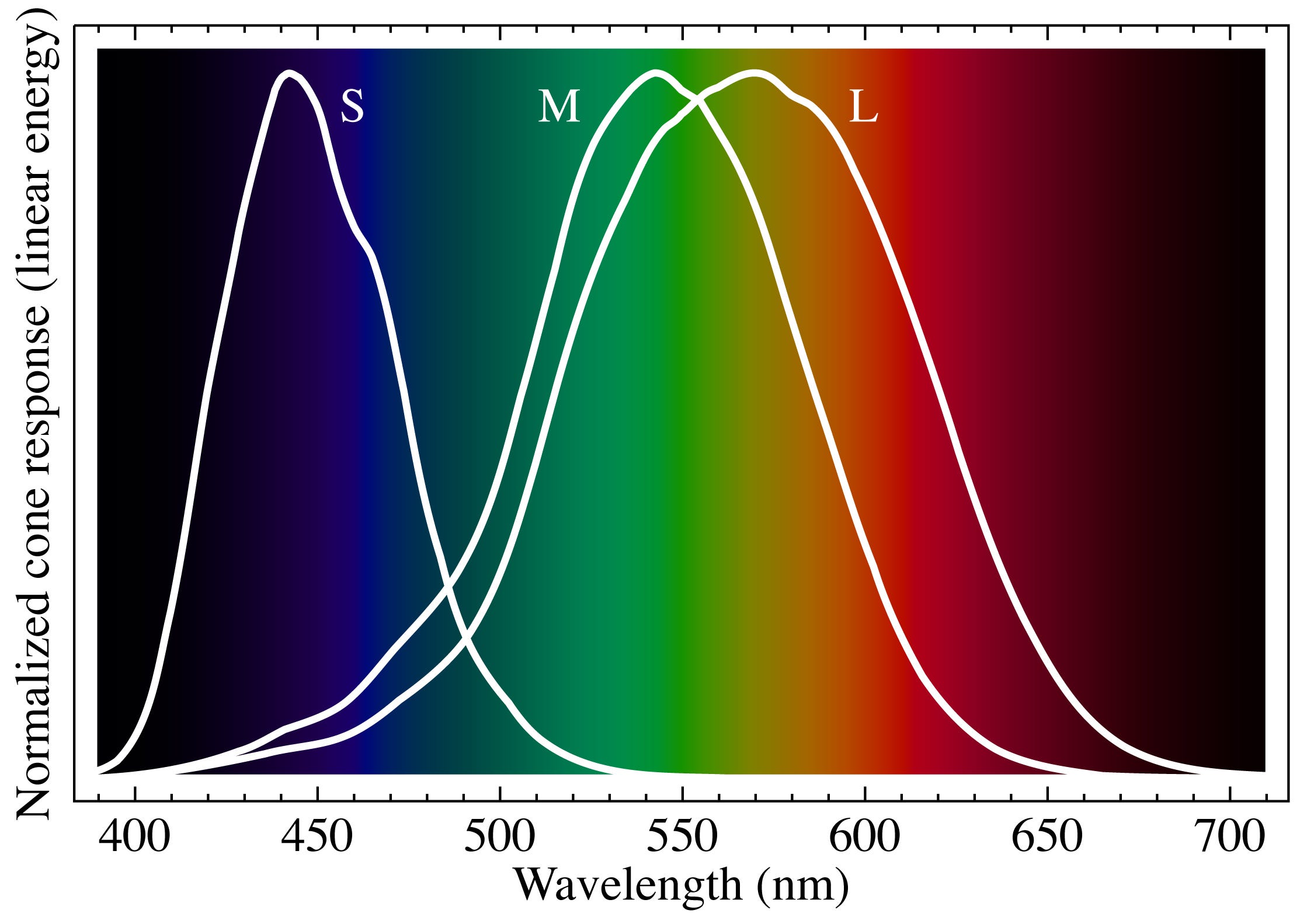

For a given point of light, all three types of cone cells respond with different magnitudes, which are then processed in two subsequent brain regions for color discrimination: the retinal ganglion cells and the lateral geniculate nucleus (LGN) in the thalamus. At this stage, the neural computation is similar to Principal Component Analysis (PCA) analysis, where a minimal number of neurons efficiently code for distinct “uncorrelated” features. The results fit into two “opponent” channels:
Red-green channel: Comparing the input from L-cones and M-cones (L-M).
Blue-yellow channel: Comparing the input from S-cones with the sum of L- and M-cone input.
This explains why we don’t perceive “reddish-green” or “yellowish-blue,” because each pair functions as two orthogonal (i.e., unrelated) axes in the color-decoding space. At the same time, many irrelevant noises are filtered out, which is crucial for computational efficiency and color constancy in later brain processing.
The output from LGN then goes to the visual cortex, including V1, V2, V4, and other higher-level regions, where all visual information (e.g., shape, size, movement) is processed hierarchically. The higher in the hierarchy, the more complex characteristics, with more features and context, the brain cells can identify in an object (e.g., faces). This convergence happens through two brain pathways. The ventral path, including parts of V2, V4, and the inferotemporal cortex, processes object identity, including properties such as shape, size, and color. The dorsal pathway, including areas V3, middle temporal (MT), and middle superior temporal (MST), primarily processes the location and motion of objects in an environment.
One of the most important functions of our color vision system is color constancy, the ability to assign colors to objects, irrespective of changes in illumination conditions in the physical environment. For example, when you see a banana in the kitchen, your perception of its yellow color remains stable, even as lighting conditions change with the time of day and weather.
Yet neuroscientists have failed to identify cells that respond only to a specific color. Their consensus is that the whole visual pathway contributes to color constancy. As visual stimuli travel through the ventral and dorsal pathways, object classification, contextual processing, and concept formation take place, while color is simply one of the properties or features associated with objects, contexts, or concepts.
Given the above, our visual system can’t be more different from a camera that records the color of every pixel in an image. Instead, it is a highly efficient coding system to process only the information useful for our everyday tasks, including identifying objects and materials, differentiating their states or conditions, and communicating with others. Without color, our ancestors would have been starving much more frequently because they would have missed ripe fruits on green trees. In other words, our brain is not built to faithfully interpret an object’s color at every instant. Instead, it uses color as an indicator of the state or condition of an object of interest to us (e.g., whether a fruit is ripe to eat or shows signs of rotting due to worms).
Recent decades of neuroscientific research suggest that, in addition to the feedforward “bottom-up” hierarchical pathway, the brain also has a feedback “top-down” loop. Our vision depends on both. Particularly, the top-down path has been found essential for humans and animals to identify an object or a color quickly without having to survey too many details or struggle with multiple alternative interpretations.
And this process can be explained extremely well by the Bayesian theorem, namely, the top-down process provides the “prior” assumption, while the bottom-up process supplies real-time updates from the external environment. Our perception is the “posterior” outcome when the assumption is updated (i.e., more or less likely) by new evidence from our eyes. The Prior includes previously formed concepts, categories, and contexts. It is holistic, judgmental, and fast. You see the banana in the kitchen is yellow, because you already knew it from previous experience. The ever-changing light conditions don’t disturb your judgment, but only strengthen your prediction. This explains the color constancy. (For more details on Bayesian inference, please refer to one of my previous articles.)
The predictive nature of color recognition was perfectly demonstrated by a real-world event in 2015, when a photograph of a dress went viral online. The dress was blue with black ribbons in the real world. Because the picture was taken in a store on a gloomy day, the upper part appeared lit by natural light, while the lower part by bluish artificial light. The photo went viral overnight because many people saw the address as white with gold ribbons, rather than blue/black. The discrepancy could happen when people were staring at the same photo on the same screen. Furthermore, most people stayed consistent with the colors they first saw, regardless of how long the debate lasted with those who saw the opposite colors (you could try it yourself if you haven’t seen the photo before).
This phenomenon attracted significant interest from neuroscientists because it was unprecedented in showcasing individual differences in color constancy. In a 2017 study with 13,417 participants, about 58% reported seeing the dress as white/gold, while 29% saw it as blue/black. The remaining participants reported seeing either a mixed color (blue/gold or white/black) or other variations. The study confirms their hypothesis that a person’s prior experience plays a decisive role in their color perception. For example, those who tend to wake early (e.g., the “lark” circadian type) and spend more time outdoors are more likely to perceive the photo as taken in natural light, and therefore, recognize the dress as blue/black. Conversely, those who are “owl” types and spend more time indoors are more likely to report seeing white/gold.
In short, the study supports the hypothesis that people’s prior experiences shape their color perception, consistent with Bayesian inference. If someone implicitly thinks the dress is in a shadow, the brain will automatically discount the bluish shadow, making the dress appear more yellowish. Conversely, those who believe the dress is under natural light will see it in its original blue color.
The fact that “the dress” phenomenon has been historically so rare, and therefore so surprising to all of us, indicates that our brain’s color constancy mechanism functions exceptionally well, offering the same color experience to everyone most of the time. Considering the importance of color in our daily lives, this consistency is essential for our interactions with physical environments, communication with others, and the smooth operation of society as a whole.
Additionally, the “top-down” influence on color recognition is evident in the effect of our language. Color categorization varies widely across different languages. For example, English has one blue among its eleven basic colors, whereas Russian has two that distinguish between light and dark blue. As a result, Russian speakers can tell apart between light and dark blue 10% faster than English speakers. Ancient Japanese had only four basic colors: black (kuro), white (hiro), red (aka), and a category encompassing blue and green (ao). Today, although Japanese has added green (midori) and explicitly designated “ao” for blue, they still refer to the green traffic light as “ao”.
Philosophy of Color
The controversy over color in philosophy mostly centers around whether it qualifies as a property of a physical object independent of observers. A tree is a physical object existing independently of us. When we don’t see it or think about it, it is still there. So are the leaves on the tree. What about the green color of the leaves? The wavelengths that they reflect from the sunlight, of course, belong to the physical world. But to many of us, color is not equal to wavelength.
Conversely, sensations of color arise in our minds as subjective interpretations of the wavelengths of light reflected from external physical objects. It can’t be created from nothing in the mind and is always associated with the object seen in the world. Those people who were blind from birth don’t know what a color is. When their vision is recovered many years later, they first see bright colors like green vs. red in days, along with light vs. dark and movement. They then develop more refined color discrimination over days or even weeks. The sensation of color needs to be learned.
So color has both objective and subjective components, like two sides of the same coin. It has created a paradox in our daily language. Is apple red? Certainly it is, which means color is a property of the apple. But it is not entirely true. To dogs and cats that do not have color vision, the same apple is not red.
Color has puzzled philosophers throughout history, and continues to do so today. There have been many camps with a spectrum swinging from “purely objective” to “purely subjective”:
Color Subjectivism/Eliminativism/Irrealism/Fictionalism: These theories deny that material objects and light sources have colors. They hold that colors are purely subjective and/or illusions of the mind.
Color Objectivism/Primitivism/Realism/Reductive Color Physicalism: Their common point is that color indeed exists as a property of objects in the physical world. In other words, physical objects are colored.
Relationism/Dispositionalism: Although both emphasize color as the relation between subjects and objects, relationism focuses more on the subjective variances, while dispositionalism underscores the power of the physical source.
In 1690, English philosopher John Locke introduced the concept of “secondary quality” in his “An Essay Concerning Human Understanding.” In his view, primary qualities are “utterly inseparable from the body” of an object and are in it “in any state” (e.g., the weight and shape of a stone, the movement of a fly). On the other hand, secondary qualities are “nothing but powers to produce various sensations in us by their primary qualities”, which include color, hot, cold, etc.
Later, Locke’s theory evolved into today’s dispositionalism and relationism. The former emphasizes that color is a disposition of objects, that is, an intrinsic property of the object, which causes color perceptions under normal conditions. The latter states that color is a relation that holds between objects, viewing conditions, and perceivers that are species- or individual-specific. Under this theory, a color must be specified using language like “a color c is perceived by x under conditions y”.
All in all, the main challenge of color for Western philosophies is that it does not fit within the object-subject binary paradigm. Color is a unity of both. It can’t be defined without defining the observer. Yet, it becomes a property attached to an external object after it is identified in the mind. It is a means for a subject to detect, discriminate, and describe a physical object based on the wavelengths characteristically reflected from the object’s surface.
Since Aristotle, science has emphasized unbiased observations, with subjects serving as “unattached” observers. However, this dichotomy has been blurred by later advances in quantum physics, where the observer and the observed are inseparable at the measurement level, and the observer plays an active role in the reality. As Danish quantum physicist Niels Bohr says,
“The state of the measuring device and the state of the object cannot be separated from each other during a measurement, but they form a dynamical whole.”
Color vision involves observers. However, it is much more complex than a measuring device. It encompasses perception, cognition, and consciousness, as the neural signals are processed along both feedforward and feedback visual pathways in the brain.
In other words, color processing in the brain spans from the straightforward interpretation of objects and light in the physical world to color constancy and subjective experience. Even more, color becomes a property associated with and indicative of things beyond natural objects, such as moods, feelings, and signs for communication. The traditional object-subject dichotomy has reached its limits in philosophizing color.
A broader principle underlying the dichotomy is reductionism, which holds that objects are and should be separable from subjects and can be observed independently of them. Although it has led to considerable success in science and technology, reductionism has repeatedly been challenged as humankind explores deeper into the mind and consciousness. The philosophy of color is one of those challenges that reductionism has faced.
Demystify Qualia of Redness
In their ground-breaking paper published in 2003, “A framework for consciousness,” neuroscientists Francis Crick and Christof Koch started with the following statement:
The most difficult aspect of consciousness is the so-called ‘hard problem’ of qualia — the redness of red, the painfulness of pain, and so on. No one has produced any plausible explanation as to how the experience of the redness of red could arise from the action of the brain.
What’s special about this experience of “the redness of red”? Can it be a “reductionized” to a single “quale”?
Based on what we have reviewed so far, the answer is no. When we say experience of the redness of red, it is the self-awareness of seeing a red object. Red is a property of the object and helps identify its state and condition. The same applies when we see a painting or a sunset. The sky is red, or the painting contains the red pigment. The consciousness of color is part of the whole coherent experience related to the object, its context, and contents from memory, where red is one of many associated features that are not divisible from the whole.
American philosopher Daniel Dennett fiercely denied the qualia of color in his 1995 book “Consciousness Explained.” He concludes that the alleged intrinsic, ineffable properties of color experience that could “float free” of physical objects simply do not exist. Instead, color experience is fully explainable by object discriminations, reactions, and judgments of a normally equipped human brain in a typical environment — no mysterious extra qualia required or even possible. For Dennett, color is where the traditional notion of qualia is most disqualified.
A classic question of qualia is, how do I know that you and I have the same subjective red when we look at red? Even if we both say it is red, how can we identify a situation where the way red things look to me is the way green things look to you? It boils down to the essence of subjectivity, which is private and not observable directly.
The above-mentioned “the dress” phenomenon shows that our perception of color is vastly consistent across individuals within a culture. The rarity of this kind of dispute suggests that we normally have the same perception when we call something red and understand it the same way when we see the same object in the same context. This is why Pantone can create a standard color-naming system used across industries such as graphic, fashion, and product design, as well as printing and manufacturing.
Back in 1982, Australian philosopher Frank Jackson described a thought experiment about scientist Mary, which raised the same question again: Does the experience of color exist separately, apart from our knowledge of the physical world?
Mary is a brilliant scientist who is, for whatever reason, forced to investigate the world from a black and white room via a black and white television monitor. She specialises in the neurophysiology of vision and acquires, let us suppose, all the physical information there is to obtain about what goes on when we see ripe tomatoes, or the sky, and use terms like ‘red’, ‘blue’, and so on. She discovers, for example, just which wave-length combinations from the sky stimulate the retina, and exactly how this produces via the central nervous system the contraction of the vocal chords and expulsion of air from the lungs that results in the uttering of the sentence ‘The sky is blue’. (It can hardly be denied that it is in principle possible to obtain all this physical information from black and white television, otherwise the Open University would of necessity need to use colour television.)
Then Jackson asks the question:
What will happen when Mary is released from her black and white room or is given a colour television monitor? Will she learn anything or not? It seems just obvious that she will learn something about the world and our visual experience of it. But then it is inescapable that her previous know-ledge was incomplete. But she had all the physical information. Ergo there is more to have than that, and Physicalism is false.
There have been numerous controversies and debates about this thought experiment, which likely will continue. The arguments center primarily around two questions. One concerns the legitimacy of the experiment, particularly regarding what constitutes “physical knowledge”. The other is whether phenomenal qualia exist (as Dennett had questioned).
Given the extensive controversies in the philosophy of color, a fundamental flaw of this thought experiment is that it assumes the color sensation is a purely subjective experience unrelated to the “physical” information. According to Physicalism, color is a physical property of the world. If Mary is restricted in the black-white world, she has been denied access to certain physical information (e.g., the wavelength ranges). Therefore, the premise statement that she possesses “all the physical information” is basically false, rendering the final question moot.
Fundamentally, we need an alternative frame when speaking specifically about color and, in general, about human perception. To English mathematician and philosopher Alfred North Whitehead, the separation of object vs subject in perceptions is a “bifurcation” of nature from one system of connected relations into “two systems of reality,” which are both “real in different senses.” It is this bifurcation that makes the perception of redness into a mysterious realm beyond nature. In his words:
The modern account of nature is not, as it should be, merely an account of what the mind knows of nature; but it is also confused with an account of what nature does to the mind. The result has been disastrous both to science and to philosophy, but chiefly to philosophy. It has transformed the grand question of the relations between nature and mind into the petty form of the interaction between the human body and mind.
Color is real. Moreover, as Whitehead emphasizes, the relationship between electromagnetic wavelengths of light and the perception of color is not causal but an interaction within the one nature itself. Traditional disciplines, such as physics, use reductive objectivism to create simple abstractions to solve complex problems. Given the advances in our understanding of how the brain perceives, including color vision, it is now time to rethink our worldview—not only to make new discoveries but also to avoid wasted energy and resources on the wrong paths.